Part 2 of 7: GCSE & A-Level STEM Success Series
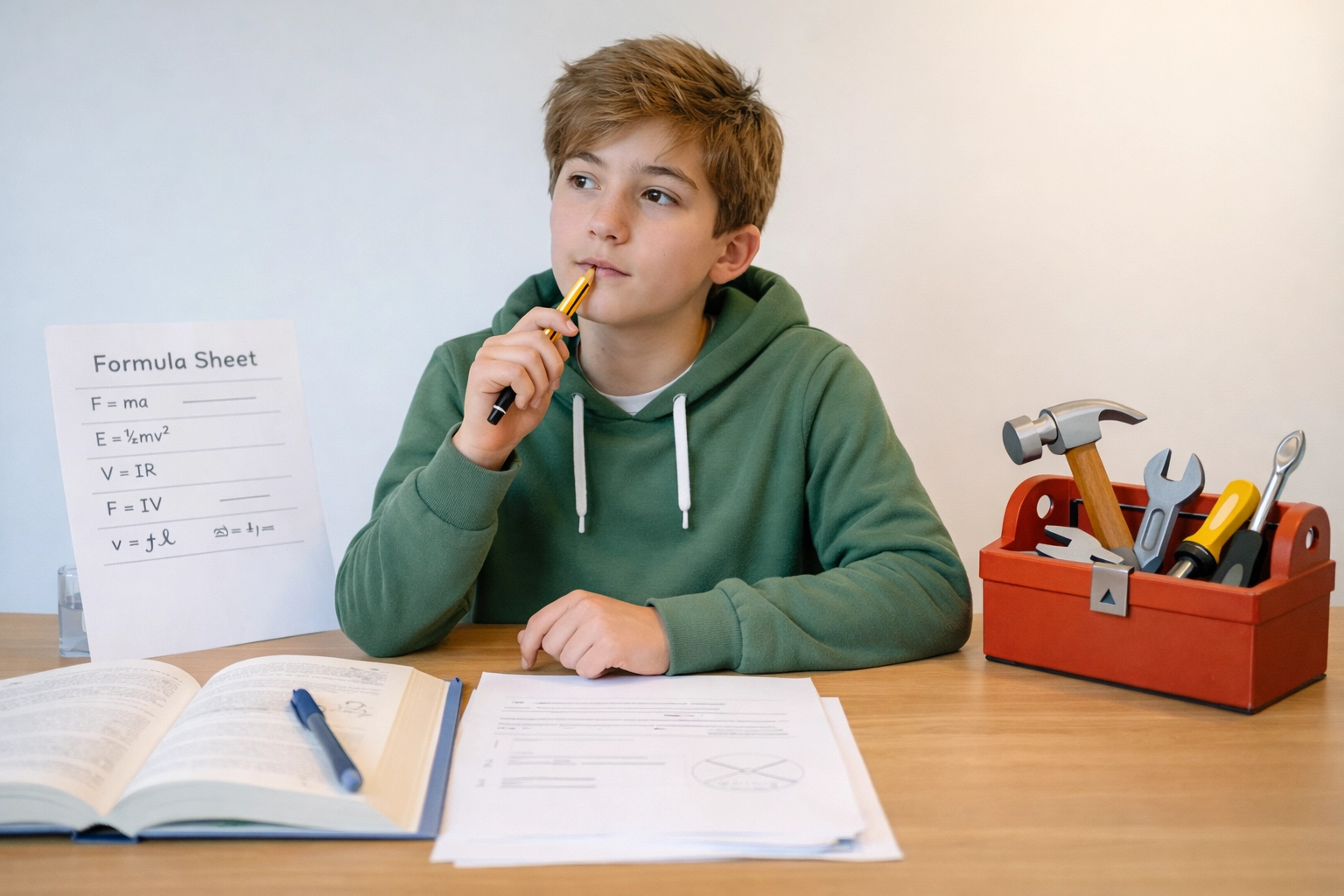
Good news landed for GCSE students in 2025, formula sheets are officially back for Physics and Combined Science exams. Your teen no longer needs to memorize dozens of equations. The Department for Education decided to include clean printed equation sheets as inserts with exam papers for 2025, 2026, and 2027.
Sounds like a win, right? It is. But here's what most parents (and students) don't realize: having the formulas doesn't mean your teen knows how to use them.
The Formula Sheet Doesn't Answer the Question
Imagine handing someone a toolbox and saying, "Build a shed." They've got all the tools, hammer, saw, nails, screwdriver, but if they don't know which tool to use when, they're stuck staring at wood and confusion.
That's exactly what happens in GCSE Science exams when students have formula sheets but lack exam technique.
Your teen might see "density = mass/volume" on the sheet, but the exam question doesn't say "calculate density." Instead, it asks: "A metal block has a mass of 800g and occupies 100cm³. Determine the material based on the data table provided."
The formula sheet can't tell them:
- Which formula applies to this question
- That they need to calculate density first
- How to convert units properly
- That they must compare their answer to the table
- How to present their working to earn method marks
Why Exam Technique Separates Grade 5s from Grade 9s
Here's where students lose marks, and it has nothing to do with not knowing formulas:
Picking the wrong equation. When six formulas involve force, velocity, and acceleration, choosing the right one under exam pressure takes practice.
Missing the context clues. Questions rarely say "use this formula." They describe scenarios, provide data, and expect students to identify what's being asked.
Forgetting to show working. Even with correct answers, students lose method marks if they don't demonstrate their process clearly.
Time management disasters. Spending 10 minutes on a 2-mark question because they're unsure which approach works wastes precious exam time.
Unit conversions. The formula sheet shows equations, not whether to use kg or g, metres or cm. Getting units wrong = lost marks.
What Actually Works? Targeted Practice
Your teen needs to practice applying formulas in exam-style contexts, not just memorizing them (which they don't even need to do anymore).
This means:
- Working through past papers with formula sheets
- Learning to identify question types by their wording
- Timing themselves under exam conditions
- Getting feedback on how they show their working, not just their final answers
At Brashan Chemistry, we focus intensively on exam technique training. Our GCSE Crash Programme teaches students exactly how to interpret questions, select formulas, and structure answers that earn maximum marks, because knowing the equations is only 30% of the battle.
Formula sheets remove one barrier. Exam technique removes the rest.
Your teen's got the tools now. Let's make sure they know how to use them.
CALL TO ACTION: Want your teen to master exam technique before their GCSEs? Explore our GCSE Crash Programme or book a free consultation to discuss their specific challenges.
DISCLAIMER: This blog series provides educational guidance for GCSE and A-Level STEM students. Individual results may vary based on student effort, starting point, and programme engagement. For personalized advice about your teen's academic journey, please CONTACT our team directly.