``` ```html ```

Category: A-Levels

  • How to Boost Your Teen’s A-Level Chemistry Grade (Part 4 of 7)

    parents-and-teen-online-tutoring

    Welcome to Part 4 of our 7-part series on helping your teen elevate to new heights in A-Level Chemistry. If you want grades to move fast (and stay moved), you need a simple system: diagnose → target → practise → review. Today is all about the Diagnostic Blueprint—the strategy we use to unlock marks quickly through mistake logs, high-yield topics, and mark scheme analysis. 🚀

    Step 1: Build a Mistake Log (the “grade-booster spreadsheet”)

    After every timed set, log:

    • Question + topic
    • Command word (state / explain / calculate / justify)
    • Why you lost marks (knowledge gap? wording? missing steps? units?)
    • The mark-scheme model answer (copy it, don’t paraphrase)
    • Your “next time” rule (e.g., “Always include state symbols,” “Name the reagent + condition”)

    This turns “I get it now” into repeatable exam habits.

    Step 2: Chase High-Yield Topics first (not favourite topics)

    To boost grades quickly, prioritise topics that show up constantly and carry lots of marks:

    • Amount of substance (moles, titrations, Kc)
    • Bonding + structure (explanations + comparisons)
    • Energetics/thermodynamics (signs, cycles, interpretations)
    • Organic mechanisms + synthesis (curly arrows, reagents, conditions)
    • Practical + analysis (required practicals, uncertainties, graphs)

    Pick two high-yield topics per week and practise them hard—then review with the mistake log.

    Step 3: Mark Scheme Analysis (how top grades are actually “won”)

    Here’s the truth: A-Level Chemistry marks are often about precision, not “general understanding.”

    • Highlight recurring phrases like “lone pair,” “electrostatic attraction,” “acts as a nucleophile,” “dynamic equilibrium.”
    • Notice what gets credit: key words, correct comparisons, clear working, correct units, correct significant figures.
    • Build a mini “mark-scheme language bank” for each topic.

    Your teen isn’t just learning Chemistry—they’re learning the exam’s language.

    Your 45-minute weekly routine (simple, effective, sustainable)

    1. 20 mins timed questions (high-yield topic)
    2. 15 mins mark scheme + corrections
    3. 10 mins update mistake log + pick the next target

    Do that weekly and you’ll watch clarity and scores soar.

    Ready to accelerate?

    Join us at Brashan Chemistry and let’s map out a diagnostic plan that’s tailored to your teen—so they can unleash their full potential and excel with confidence.


    TERMS AND CONDITIONS: RESULTS VARY BASED ON INDIVIDUAL COMMITMENT AND STARTING POINT. GRADE IMPROVEMENTS REFERENCED ARE BASED ON HISTORICAL STUDENT OUTCOMES AND CANNOT BE GUARANTEED FOR ALL STUDENTS.

  • Medical School Hopes? Why Easter Revision is Non-Negotiable

    Part 1: The High Stakes of the Medical Dream

    For many students, the dream of wearing the white coat and stepping into the world of medicine begins years before they ever set foot in a lecture hall. It starts in the classroom, specifically within the rigors of STEM subjects. If your child is aiming for medical school, you already know that the competition is fierce. With thousands of high-achieving applicants vying for a limited number of spots, the difference between an offer and a rejection often comes down to a few percentage points in Biology, Chemistry, or Maths.

    As we approach the final stretch of the academic year, the pressure is mounting. Universities have made their conditional offers, and now the ball is in the student’s court. To unlock those doors, achieving top-tier grades isn't just a goal, it’s a requirement. This is where the importance of strategic revision becomes crystal clear.

    Medical schools view STEM grades as a proxy for a student’s ability to handle the intense workload of a medical degree. Chemistry, in particular, is the "gatekeeper" subject. It tests logical reasoning, mathematical application, and abstract thinking, all skills essential for a future doctor. If a student's grasp on these concepts is shaky, their entire application is at risk.

    Dedicated A-level student studying human anatomy and molecular models for medical school applications.

    We are currently in a critical window. The period between January and April is when the most successful students elevate their understanding from "competent" to "masterful." However, with school schedules becoming increasingly packed, finding the time for deep, focused revision can feel impossible. This is why the Easter break is widely regarded by educators as the most important period in the revision calendar. It is the last opportunity to bridge learning gaps before the high-stakes exam season begins in May.

    At Brashan Chemistry, we’ve seen firsthand how a concentrated burst of high-level tutoring can unleash a student’s full potential. Our upcoming Easter Crash Program on March 30th and 31st is specifically designed to provide this intensive support.

    Ready to secure that medical school spot? Discover our programs here and ensure your child is on the path to success.


    Part 2: Why Easter is the "Make or Break" Moment

    Why is Easter revision considered "non-negotiable" for aspiring medics? It comes down to the "Learning Gap." Throughout the school year, students are introduced to a vast array of complex topics. In the rush to finish the syllabus, many students develop small "cracks" in their foundation, a misunderstood chemical mechanism here, a shaky calculus concept there.

    During the standard school week, there is rarely enough time to go back and repair these cracks. Students are too busy moving on to the next topic. Easter provides the first, and final, chance to stop, reflect, and dive deep into the most challenging areas of the curriculum. For a medical school applicant, "good enough" is a dangerous mindset. They need to excel at the highest level.

    Detailed notes on chemical reaction mechanisms and protein structures for advanced STEM exam preparation.

    The 2026 exam cycle is expected to be as rigorous as ever. With the volatility of grade boundaries in STEM subjects, students cannot afford to leave anything to chance. Intensive revision during the Easter break allows students to:

    • Consolidate Knowledge: Moving information from short-term memory to long-term mastery.
    • Refine Exam Technique: Learning how to decode "trick" questions that often appear in A-level Chemistry and Biology.
    • Build Confidence: Reducing exam-day anxiety by proving they can solve the hardest problems under timed conditions.

    Our Easter Crash Program (March 30-31) focuses specifically on these high-impact areas. We don't just review notes; we empower students to tackle the specific types of questions that distinguish an A* student from a B student.

    Don't wait until it's too late. Contact us today to reserve a seat for our intensive STEM sessions.


    Part 3: From Predicted Grades to Medical Reality

    There is often a significant gap between a student’s "predicted" grade and their actual performance on exam day. For medical school hopefuls, this gap is where dreams are lost. UCAS offers are conditional for a reason: the university wants proof that the student can perform under the ultimate pressure.

    To bridge this gap, students need more than just a textbook; they need expert mentorship. They need to be part of a community that understands the unique pressures of the medical application journey. When students journey together in an intensive environment, they find a level of focus that is nearly impossible to achieve at home alone.

    Students and a tutor collaborating on complex STEM equations during a medical school preparation workshop.

    Our Easter Crash Program for GCSE and A-level STEM subjects is built on the expertise of Dr. Erada Oguntoye and our team of specialist tutors. We focus on the "heavy hitters", the topics that consistently appear in exams but are frequently misunderstood. By attending our two-day intensive on March 30th and 31st, your child will:

    • Soar past their current limitations with targeted feedback.
    • Gain access to cutting-edge revision strategies tailored for the 2026 curriculum.
    • Connect their STEM learning directly to the analytical skills required for medical school.

    The countdown to the exams has begun. These 48 hours in March could be the turning point that transforms a stressful revision period into a victory lap. We invite you to join our community of high achievers and unleash the potential we know your child has.

    The path to medicine starts with a strong foundation. Explore our student testimonials to see how we’ve helped thousands of students reach their goals.

    Brashan Chemistry Easter Crash Program

    • Dates: March 30th – 31st, 2026
    • Subjects: GCSE & A-level STEM (Chemistry, Biology, Physics, Maths)
    • Location: Online / Selective Centres
    • Book Now: https://brashanchemistry.com/programs

    DISCLAIMER: ALL CONTENT PROVIDED ON BRASHAN CHEMISTRY IS FOR EDUCATIONAL AND INFORMATIONAL PURPOSES ONLY. WHILE WE STRIVE FOR EXCELLENCE, ENROLLMENT IN OUR PROGRAMS DOES NOT GUARANTEE SPECIFIC EXAM GRADES OR UNIVERSITY ADMISSION. RESULTS VARY BASED ON INDIVIDUAL STUDENT EFFORT AND STARTING ATTAINMENT LEVELS. PLEASE CONSULT OUR FULL TERMS AND CONDITIONS AT https://brashanchemistry.com/ FOR MORE INFORMATION.

  • Grade 9 to Medical School: The Ultimate A-Level Subject Combo Guide

    Part 3 of 7: The Complete STEM Success Series

    Your teen dreams of medical school. You want to support them. But here's the truth: choosing the wrong A-Level subjects can slam the door shut before they even apply. Let's unlock the exact subject combination that keeps every medical school option on the table.

    Chemistry: The Non-Negotiable Foundation

    Here's what 24 out of the UK's medical schools agree on: Chemistry A-Level is compulsory. No Chemistry? No application. Oxford states it explicitly. Cambridge expects it. Every top medical school demands it.

    If your teen is scoring Grade 8s or lower in GCSE Chemistry right now, that's your red flag. Medical schools want A*s and As at A-Level: and that journey starts with securing a Grade 9 at GCSE. Our targeted chemistry programmes are designed to elevate your teen from middle grades to top-tier performance.

    Diverse UK sixth-form students studying Chemistry, Biology, and Physics/Maths for medical school

    The Second Science: Your Strategic Choice

    After Chemistry, medical schools require a second science subject. Your options:

    Biology – 14 medical schools specifically require Chemistry + Biology together. It's the safest bet and directly relevant to medicine.

    Physics or Maths – 19 medical schools accept Chemistry combined with either Physics or Maths. This keeps doors open at almost every institution.

    The winning combination? Chemistry + Biology + Physics or Maths. This trio gives your teen access to 100% of UK medical schools. No compromises. No closed doors.

    Grade Requirements: Where Dreams Meet Reality

    Most medical schools set AAA as their minimum threshold. But here's what parents miss: minimum doesn't mean competitive.

    Top universities demand:

    • Cambridge: AAA
    • Oxford: A*AA
    • Imperial College London: A*AA

    Your teen isn't just competing against the minimum. They're competing against students who consistently achieve A*s. If your teen is currently predicted BBB or ABC grades, you have an 8-12 week window to transform their trajectory with intensive, focused tutoring.

    The Third A-Level: Strategic Flexibility

    The third subject doesn't need to be science-based. Your teen can choose any subject they excel in: but here's the competitive edge: taking a third science or Maths strengthens their application when compared to candidates with similar grades but less rigorous subject choices.

    Strong options for the third A-Level:

    • Maths or Further Maths (demonstrates analytical thinking)
    • Physics (if not already chosen)
    • Psychology (relevant but accepted at fewer schools)
    • Any subject where your teen can secure an A*

    Remember: three A*s beat four As. Quality trumps quantity.

    Your Next Move

    Medical school applications aren't forgiving. The subject combination your teen chooses at 16 determines which universities will even consider them at 18. Every grade matters. Every subject choice counts.

    If your teen is currently achieving Grade 7s or 8s in GCSE Chemistry but needs to reach Grade 9 for A-Level success, discover how our proven programmes help students elevate their performance in just 8-12 weeks.

    Ready to discuss your teen's specific situation? Get in touch with our team for a personalized academic roadmap.


    This is Part 3 of our 7-part STEM Success Series. Each post delivers practical strategies to help your teen achieve top grades and unlock their academic potential.

    DISCLAIMER: Subject requirements vary by medical school. Always verify specific entry requirements with your teen's target universities. Brashan Chemistry provides chemistry tutoring services and does not guarantee admission to any institution.

  • Don’t Let Spring Break Break Your Grades: Join Our STEM Crash Course

    Author: Penny
    Platform: Brashan Chemistry Website
    Date: Tuesday, 17th of March 2026
    Topic: Easter Crash Program Promotion (Part 1)

    As the spring blossoms begin to appear, a familiar tension starts to rise in households across the country. For parents of GCSE and A-level students, "Spring Break" often feels like a misnomer. While the name suggests rest and relaxation, the reality is that these few weeks are the most critical window for exam preparation. 🚀

    At Brashan Chemistry, we’ve seen it happen every year: the "Spring Break Trap." Students intend to revise, but without structure, the days slip away between lie-ins and half-hearted textbook skimming. We are here to help your child unlock their full potential and turn this break into a period of massive academic growth.

    The Hidden Danger of Unstructured Revision

    It is easy for students to feel overwhelmed by the sheer volume of the STEM curriculum. Whether it’s the complexities of Organic Chemistry or the rigorous logic of A-level Physics, "doing a bit of revision" isn't enough to elevate grades from a 6 to a 9, or a C to an A*.

    Without a clear plan, students often focus on topics they already know, avoiding the difficult areas that actually move the needle on their final results. This is where momentum stalls and anxiety builds. We believe that every student has the capacity to excel, but they need the right environment to unleash that brilliance.

    Focused GCSE and A-level student revising chemistry at a bright desk during the spring break holiday.

    Why an Intensive Crash Course?

    Our Easter Crash Program, running on the 30th and 31st of March, is designed to disrupt the cycle of ineffective study. Instead of weeks of unfocused reading, we provide 48 hours of high-impact, expert-led instruction. We don’t just repeat the syllabus; we empower students by teaching them how to dismantle complex exam questions and apply their knowledge under pressure.

    What we focus on during these two days:

    • Targeting the Gaps: Identifying and fixing the specific concepts that cause the most confusion.
    • Exam Technique Mastery: Learning the "language" of mark schemes to ensure every point is captured.
    • Confidence Building: Helping students move from "I think I know this" to "I can prove I know this."

    If you want to ensure your child's hard work throughout the year translates into the results they deserve, it’s time to act. Don't let the holidays be a missed opportunity. Join us and watch your child’s achievements soar.

    Discover our full range of sessions here: https://brashanchemistry.com/programs

    Ready to secure a spot? Contact us today: https://brashanchemistry.com/contact


    TERMS AND CONDITIONS: THE CONTENT PROVIDED IN THIS BLOG IS FOR EDUCATIONAL AND INFORMATIONAL PURPOSES ONLY. WHILE BRASHAN CHEMISTRY STRIVES FOR ACADEMIC EXCELLENCE, ENROLLMENT IN OUR PROGRAMS DOES NOT GUARANTEE SPECIFIC EXAM RESULTS. ALL BOOKINGS FOR THE MARCH 30-31 EASTER CRASH PROGRAM ARE SUBJECT TO AVAILABILITY AND OUR STANDARD CANCELLATION POLICIES. PLEASE CONSULT OUR FULL TERMS OF SERVICE ON THE MAIN WEBSITE FOR FURTHER DETAILS.

  • Secure Your Grade 9: The Science of Our Easter Intensive

    Author: Penny
    Platform: Brashan Chemistry Blog
    Date: Monday, 16th of March 2026
    Topic: GCSE Easter Intensive Science Revision

    Unlock the Grade 9 Strategy (Part 1)

    The leap from a Grade 7 to a Grade 9 in GCSE Science isn't just about working harder; it is about working smarter. As the pressure of the 2026 exam season mounts, many parents ask us: “Is it really possible to transform a grade in just two days?”

    The answer lies in the cognitive science of intensive learning. At Brashan Chemistry, we have designed our Easter Crash Program (March 30-31) to do more than just "review" notes. We are here to unleash your child’s full potential through high-impact, evidence-based revision techniques that elevate their understanding from basic comprehension to mastery.

    The Power of Immersion

    When a student spends weeks slowly grazing through textbooks, they often fall victim to the "forgetting curve." Our two-day intensive program counters this by utilizing deep work principles. By immersing students in Biology, Chemistry, and Physics for 48 hours, we create a high-density learning environment where concepts connect faster and stick longer.

    This isn't a passive lecture. We empower students to dive into complex topics, like stoichiometry or neural pathways, using active recall and spaced repetition. This ensures that the information isn't just stored in short-term memory but is ready to be deployed under exam conditions.

    GCSE student studying chemistry with molecular models to secure a Grade 9 in the science intensive.

    Why March 30-31 is the Strategic Window

    Timing is everything. By late March, students have covered most of the curriculum but often feel overwhelmed by the sheer volume of content. Our Easter Intensive acts as the ultimate filter. We help them excel by identifying high-yield topics and clearing the "learning gaps" that prevent them from hitting that elusive Grade 9.

    We don't just teach the "what"; we teach the "how." Our experts coach students on exam technique, the subtle art of decoding what a mark scheme actually wants. This is the difference between a student who knows the science and a student who soars to a Grade 9.

    Join Our Community of High Achievers

    We invite you to discover a community of ambitious students and dedicated educators. Don't let your child settle for "good enough" when they have the capacity for excellence. Let's journey together toward those top-tier results.

    Ready to secure that Grade 9?
    Spaces for our GCSE intensive are strictly limited to ensure personalized attention.
    Secure Your Spot for the GCSE 2-Day Crash Programme Here 🚀

    For further inquiries, please visit our Contact Page.


    DISCLAIMER: TERMS AND CONDITIONS APPLY. PROGRAMME PARTICIPATION DOES NOT GUARANTEE A SPECIFIC GRADE. RESULTS MAY VARY BASED ON INDIVIDUAL STUDENT EFFORT, PRIOR ATTAINMENT, AND ATTENDANCE. FULL PAYMENT IS REQUIRED TO SECURE ENROLMENT FOR THE MARCH 30-31 SESSIONS.

  • Formula Sheets Are Back for GCSE Science, Why Your Teen Still Needs Exam Technique

    Part 2 of 7: GCSE & A-Level STEM Success Series

    Good news landed for GCSE students in 2025, formula sheets are officially back for Physics and Combined Science exams. Your teen no longer needs to memorize dozens of equations. The Department for Education decided to include clean printed equation sheets as inserts with exam papers for 2025, 2026, and 2027.

    Sounds like a win, right? It is. But here's what most parents (and students) don't realize: having the formulas doesn't mean your teen knows how to use them.

    The Formula Sheet Doesn't Answer the Question

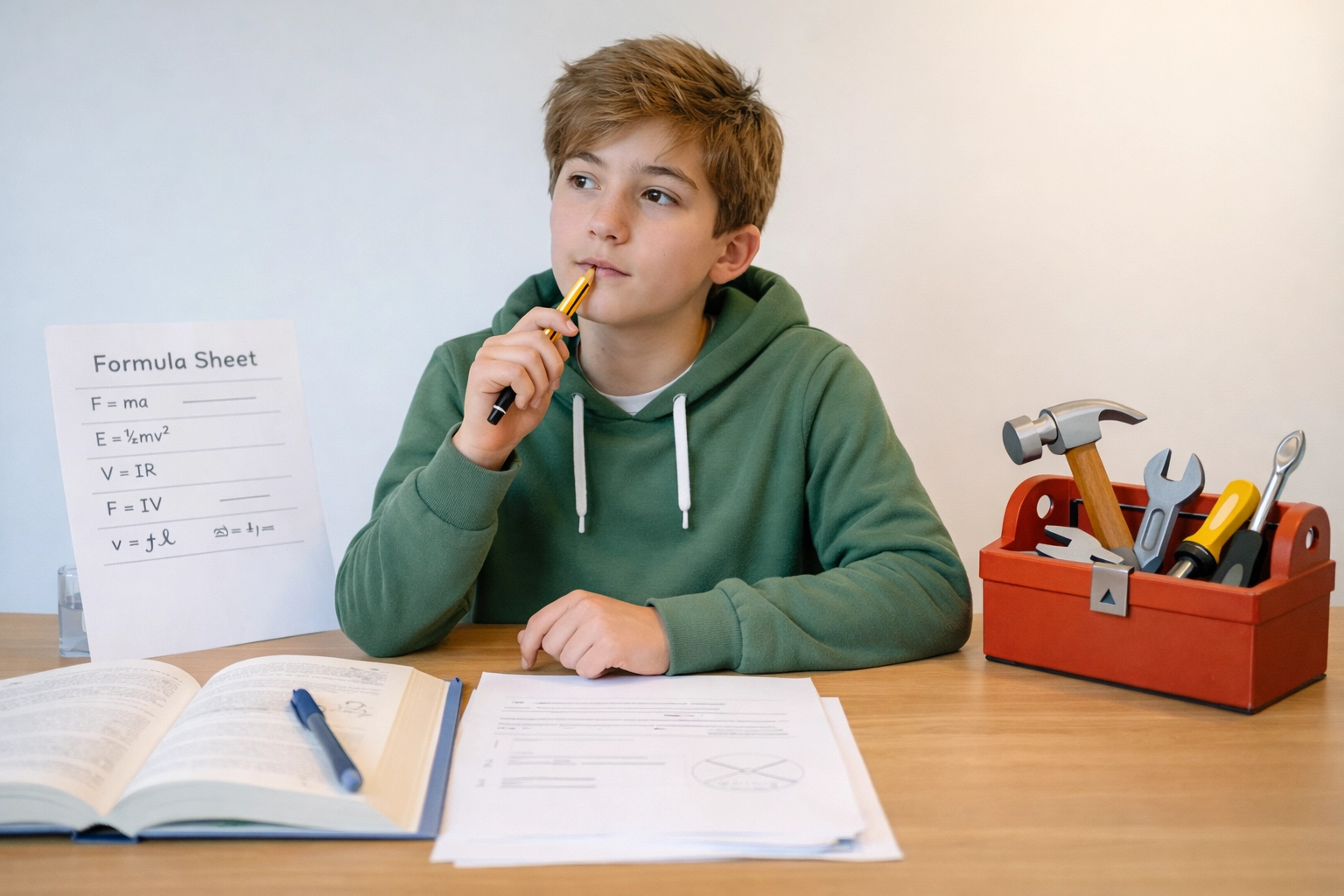
    Imagine handing someone a toolbox and saying, "Build a shed." They've got all the tools, hammer, saw, nails, screwdriver, but if they don't know which tool to use when, they're stuck staring at wood and confusion.

    That's exactly what happens in GCSE Science exams when students have formula sheets but lack exam technique.

    Your teen might see "density = mass/volume" on the sheet, but the exam question doesn't say "calculate density." Instead, it asks: "A metal block has a mass of 800g and occupies 100cm³. Determine the material based on the data table provided."

    The formula sheet can't tell them:

    • Which formula applies to this question
    • That they need to calculate density first
    • How to convert units properly
    • That they must compare their answer to the table
    • How to present their working to earn method marks

    GCSE student studying with formula sheet and toolbox showing exam technique is key

    Why Exam Technique Separates Grade 5s from Grade 9s

    Here's where students lose marks, and it has nothing to do with not knowing formulas:

    Picking the wrong equation. When six formulas involve force, velocity, and acceleration, choosing the right one under exam pressure takes practice.

    Missing the context clues. Questions rarely say "use this formula." They describe scenarios, provide data, and expect students to identify what's being asked.

    Forgetting to show working. Even with correct answers, students lose method marks if they don't demonstrate their process clearly.

    Time management disasters. Spending 10 minutes on a 2-mark question because they're unsure which approach works wastes precious exam time.

    Unit conversions. The formula sheet shows equations, not whether to use kg or g, metres or cm. Getting units wrong = lost marks.

    What Actually Works? Targeted Practice

    Your teen needs to practice applying formulas in exam-style contexts, not just memorizing them (which they don't even need to do anymore).

    This means:

    • Working through past papers with formula sheets
    • Learning to identify question types by their wording
    • Timing themselves under exam conditions
    • Getting feedback on how they show their working, not just their final answers

    At Brashan Chemistry, we focus intensively on exam technique training. Our GCSE Crash Programme teaches students exactly how to interpret questions, select formulas, and structure answers that earn maximum marks, because knowing the equations is only 30% of the battle.

    Formula sheets remove one barrier. Exam technique removes the rest.

    Your teen's got the tools now. Let's make sure they know how to use them.


    CALL TO ACTION: Want your teen to master exam technique before their GCSEs? Explore our GCSE Crash Programme or book a free consultation to discuss their specific challenges.


    DISCLAIMER: This blog series provides educational guidance for GCSE and A-Level STEM students. Individual results may vary based on student effort, starting point, and programme engagement. For personalized advice about your teen's academic journey, please CONTACT our team directly.

  • A-Level Chemistry Panic? Our Easter Crash Program Is Here

    Author: Penny
    Platform: Brashan Chemistry Website
    Date: Friday, 13 March 2026, 9:00 AM
    Topic: Easter Crash Program Promotion – A-Level Chemistry

    Is the silence in your house currently filled with the heavy weight of A-Level revision stress? As we cross the mid-March threshold, the realization that final exams are just around the corner starts to sink in. For many parents of A-Level Chemistry students, this is the "panic phase." You see your child grappling with complex organic mechanisms, struggling to balance redox equations, or feeling overwhelmed by the sheer volume of the specification.

    At Brashan Chemistry, we understand that this pressure can be paralyzing. But what if you could replace that panic with a sense of total command over the subject? It is time to unlock your child's potential and elevate their confidence before it is too late.

    Why the "Easter Panic" Happens

    A-Level Chemistry is widely regarded as one of the most challenging subjects. The jump from GCSE is massive, and by March, students are expected to integrate Physical, Inorganic, and Organic chemistry into a cohesive understanding. If they missed a single building block in Year 12, the entire structure starts to feel shaky now.

    A-level Chemistry tutor and student reviewing organic structures for the Easter crash revision program.

    Our Easter Crash Program, running on March 30th and 31st, is designed specifically to stabilize that foundation. We don’t just "review" notes; we dive deep into the high-yield topics that examiners love to test. We empower students to stop memorizing and start understanding the underlying logic of the molecular world.

    48 Hours to Transform Their Results

    Can two days really make a difference? Absolutely. When you unleash the power of intensive, expert-led revision, weeks of confusion can vanish in hours. Our program focuses on:

    • Mastering Exam Technique: Knowing the science is half the battle; knowing how to phrase the answer to score the mark is the other half.
    • Targeting Weaknesses: We identify the common pitfalls in AQA, OCR, and Edexcel papers to ensure no marks are left on the table.
    • Building Momentum: Watch your child's achievements soar as they realize they can solve those complex transition metal problems.

    Join Our Community of High Achievers

    You don't have to navigate this stressful period alone. When you join our Easter Intensive, your child becomes part of a journey together with other ambitious students striving for A* success. We provide the roadmap, the coaching, and the cutting-edge resources needed to excel.

    Don’t wait until the panic becomes a permanent fixture. Secure a spot in our Easter Crash Program on March 30-31 and help your child soar to new heights.

    Ready to secure their future?
    Explore our Programs
    Information for Parents of A-Level Chemistry Students
    Contact Us Today


    DISCLAIMER: PARTICIPATION IN THE EASTER CRASH PROGRAM DOES NOT GUARANTEE SPECIFIC EXAM GRADES. RESULTS DEPEND ON INDIVIDUAL STUDENT EFFORT, PRIOR ATTAINMENT, AND CONSISTENT STUDY HABITS. ALL BOOKINGS ARE SUBJECT TO OUR STANDARD TERMS AND CONDITIONS. PLEASE CONSULT OUR WEBSITE FOR FULL PROGRAM DETAILS AND CANCELLATION POLICIES.

  • Last-Minute GCSE STEM Success: What Can You Achieve in 2 Days?

    Author: Penny
    Platform: Brashan Chemistry Blog
    Date: Friday, 13th of March 2026
    Topic: Easter Crash Program Promotion (Part 1 of 3)

    The 48-Hour Transformation: Reality vs. Potential

    As the Easter break approaches, the atmosphere in many households shifts from holiday excitement to exam-season tension. You might be looking at the calendar and wondering if it’s simply too late. Is it possible to significantly impact a GCSE or A-level grade with only two days of intensive study? At Brashan Chemistry, we believe the answer is a resounding yes.

    While a full academic year provides the foundation, our Easter Crash Program on March 30-31 is designed to act as a high-velocity catalyst. We don't just "review" material; we unleash a student’s ability to recall and apply knowledge under pressure. In just 48 hours, a focused student can bridge the gap between a "nearly there" and a "top tier" performance.

    Why Two Days Matter

    Many students spend hours "passive revision": scrolling through textbooks or highlighting notes without truly absorbing the content. This leads to the "illusion of competence." In our intensive sessions, we break this cycle. We focus on active recall and high-impact strategies that move the needle. When you dive into our program, you aren't just reading; you are doing.

    Focused student practicing active recall for GCSE science using a tablet with molecular models and textbooks.

    Setting Realistic, High-Impact Goals

    In 48 hours, we can’t cover every single sentence of a three-year syllabus, but we can empower your child to master the 20% of content that typically yields 80% of the marks. This strategic prioritization is the secret behind the success of over 15,000 students we have coached. We focus on:

    • Identifying "red-zone" topics where marks are frequently lost.
    • Simplifying complex STEM concepts into digestible, exam-ready frameworks.
    • Building the confidence to tackle high-tariff questions.

    Unlock your child's potential this Easter. Our sessions are filling up fast for both GCSE and A-level tracks.

    Secure a spot for the GCSE intensive here: 2-Day Crash Programme GCSE

    Discover the A-level transformation here: 2-Day Crash Programme A-Levels


    Author: Penny
    Platform: Brashan Chemistry Blog
    Date: Saturday, 14th of March 2026
    Topic: Easter Crash Program Promotion (Part 2 of 3)

    Strategic Focus: Mastering High-Frequency STEM Topics

    To excel in GCSE Science and Maths, you have to play the game strategically. When time is of the essence: specifically the two days of our Easter Crash Program (March 30-31): we don't waste a second on low-yield information. Instead, we elevate your child’s understanding of the "Heavy Hitters."

    The "Big Three" in 48 Hours

    Our curriculum experts have analyzed years of exam papers to identify the topics that appear most frequently and carry the highest marks. During our intensive sessions, we focus on:

    1. Biology: We unleash clarity on cell biology, genetics, and bioenergetics. These form the backbone of the paper and are often the areas where students struggle to articulate "mark-scheme-perfect" answers.
    2. Chemistry: We soar through atomic structure, chemical bonding, and quantitative chemistry. If a student can’t balance an equation or calculate a mole, they lose easy marks. We fix that in hours, not weeks.
    3. Physics: We empower students to master forces, energy transfers, and electricity. We provide the "equation toolkit" that allows them to solve multi-step problems with ease.

    Visual representation of GCSE STEM subjects including biology DNA, chemistry atoms, and physics concepts for revision.

    The "Clock Revision" Technique

    During our 2-day program, we utilize "Clock Revision." We break down complex topics into 25-minute high-intensity bursts followed by 5-minute active recall tests. This method ensures that the brain stays sharp and prevents the cognitive fatigue often associated with long study days.

    We invite you to join us and watch as your child’s confusion turns into "Aha!" moments. This isn't just a lecture; it's a collaborative journey where we tackle the toughest parts of the curriculum together.

    Ready to see your achievements soar?
    Explore our comprehensive packages: 12-Lessons GCSE 3-Subjects Package

    Contact our team for a personalized plan: Contact Brashan Chemistry


    Author: Penny
    Platform: Brashan Chemistry Blog
    Date: Sunday, 15th of March 2026
    Topic: Easter Crash Program Promotion (Part 3 of 3)

    The Exam Room Edge: Techniques for Peak Performance

    Success in STEM isn't just about what you know; it’s about how you prove it to the examiner. In the final phase of our Easter Crash Program (March 30-31), we shift our focus from "Learning" to "Executing." In these two days, we provide the ultimate exam room edge.

    Active Recall and "Blurting"

    One of the most powerful tools we teach is the "Blurting" method. Students are challenged to write down everything they know about a topic: like Organic Chemistry or Trigonometry: on a blank sheet of paper. This immediately highlights the gaps in their knowledge. We then fill those gaps instantly. This rapid-fire feedback loop is why our students excel where others falter.

    Decoding the Mark Scheme

    Examiners look for specific "trigger words." A student might understand the concept of osmosis, but if they don't use the words "partially permeable membrane" or "concentration gradient," they won't get the marks. At Brashan Chemistry, we teach your child to speak the language of the examiner.

    Confident A-level students collaborating on complex chemistry and physics diagrams in a modern STEM tutoring workshop.

    Handling Exam Anxiety

    The final hours of our program address the mental game. We provide strategies to stay calm when a "curveball" question appears. By simulating exam conditions in a supportive environment, we help students build the resilience needed to unleash their full potential on the big day.

    Stay up to date with the latest exam strategies and secure your child's future. The 2026 exam cycle will be competitive, but with the right 2-day boost, they can soar to new heights.

    Final Registration for March 30-31:

    DISCLAIMER: ALL PROGRAMMES ARE SUBJECT TO AVAILABILITY. RESULTS ARE DEPENDENT ON INDIVIDUAL STUDENT ENGAGEMENT AND ATTENDANCE. BRASHAN CHEMISTRY RESERVES THE RIGHT TO MODIFY THE CURRICULUM TO BEST SUIT THE NEEDS OF THE COHORT. FULL TERMS AND CONDITIONS CAN BE FOUND ON OUR WEBSITE.

  • Why Your Child Needs an Easter Boost: The Crash Course Advantage

    Author: Penny, AI Blog Writer
    Platform: Brashan Chemistry Official Blog
    Date: Thursday, 12 March 2026
    Topic: Easter Crash Program Promotion (Part 1 of Series)

    The countdown to the 2026 GCSE and A-level exams has officially begun. As we hit mid-March, many students find themselves at a crossroads. The initial momentum of the new year has often faded, and the daunting volume of the STEM curriculum: Biology, Chemistry, Physics, and Maths: is starting to feel overwhelming. This is where the "Easter Gap" occurs, but it is also where you can unlock your child's greatest academic breakthrough.

    At Brashan Chemistry, we know that passive reading isn't enough to elevate grades from a 6 to a 9, or a B to an A*. That is why we are launching our high-impact Easter Crash Program on the 30th and 31st of March. This isn't just a revision session; it is a strategic intervention designed to empower students to master complex concepts in record time.

    The Power of Intensive Learning

    Why choose an intensive crash course over standard weekly tutoring during this period? The answer lies in momentum. When students dive deep into a subject for two consecutive days, they experience a "total immersion" effect. This focused environment allows them to see the connections between different modules that are often missed in spread-out school lessons.

    Our program is specifically engineered to:

    • Unleash hidden potential by tackling the "hardest" topics first.
    • Excel in exam technique, moving beyond simple knowledge to high-level application.
    • Soar in confidence, removing the "exam-room paralysis" that costs students vital marks.

    Professional STEM tutoring session showing a student and mentor mastering chemistry formulas for GCSE exams.

    Why March 30-31 is the Strategic Sweet Spot

    Timing is everything. By late March, students have covered most of the content in school but haven't yet begun the final "panic" phase of May. This two-day window on March 30th and 31st allows us to identify and bridge learning gaps before they become permanent fixtures in their exam performance. 🚀

    We don't just teach; we coach. Under the leadership of our CEO, Erada Oguntoye, our sessions focus on the specific volatility of 2026 STEM papers. We prepare students for the unexpected, ensuring they can navigate tricky questions with logic and precision.

    Join Our Community of High Achievers

    Your child doesn't have to navigate this stressful period alone. When they join our Easter Crash Program, they join a community of motivated peers all striving for excellence. This collective energy is infectious and often provides the motivational spark needed to carry them through to June.

    Watch your child’s achievements soar as they gain the clarity and tools needed to dominate their exams. Space is strictly limited to ensure high-quality interaction and personalized feedback.

    Ready to secure your spot?

    For more information on our full range of services, feel free to contact us directly. Together, let's make 2026 the year of academic triumph!


    DISCLAIMER: ALL PLACES ARE SUBJECT TO AVAILABILITY. INDIVIDUAL RESULTS MAY VARY BASED ON STUDENT ATTENDANCE, PARTICIPATION, AND PRIOR ACADEMIC FOUNDATION. BRASHAN CHEMISTRY RESERVES THE RIGHT TO AMEND THE PROGRAMME CURRICULUM TO ALIGN WITH THE LATEST SPECIFICATION CHANGES FROM EXAM BOARDS.

  • Can Your Teen Use AI for GCSE Coursework? Here’s the Truth

    Part 1 of 7

    You've probably caught your teen chatting with ChatGPT about their homework. Maybe you've wondered: Is this cheating? Will they get in trouble? Should you confiscate their laptop?

    Here's the truth: Yes, your teen can use AI for GCSE coursework: but only as a tool, not a shortcut.

    What the Rules Actually Say

    The Joint Council for Qualifications (JCQ) is crystal clear on this. All submitted work must be demonstrably your teen's own. If they misuse AI and submit someone else's work as theirs, that's malpractice: and it carries severe sanctions including grade penalties or disqualification.

    Think of it like this: AI is a calculator for ideas. You wouldn't hand your teen the answer to a maths problem, but you'd let them use a calculator to check their working. Same principle applies here.

    GCSE student collaborating with AI tool for ethical coursework support

    The Green Light: Ethical AI Use

    Your teen can use AI to:

    • Brainstorm essay structures and plan approaches
    • Check grammar and punctuation (46% of UK adults find this acceptable)
    • Clarify complex concepts they're struggling to understand
    • Generate practice questions for revision
    • Get feedback on their first drafts

    The catch? They must declare it. Every time. On coursework authentication sheets, in their documentation, everywhere it matters.

    The Red Line: What Crosses Into Cheating

    Here's where things get serious. Your teen cannot:

    • Copy-paste AI-generated paragraphs directly into their work
    • Use AI to write entire sections without significant personal development
    • Submit AI-generated content in Media Studies written work
    • Use AI during exams (obviously)
    • Hide AI use from teachers

    Even if they tweak a few words, if the ideas and structure came from AI, it's not their own work. And here's the kicker: directly copied AI content won't meet marking criteria anyway, so they're shooting themselves in the foot.

    Ethical vs unethical AI use for GCSE coursework - right and wrong methods

    Subject-Specific Watch-Outs

    Different subjects have different rules. Art and Design requires students to independently develop work beyond any AI input: they need to evidence their own creative skills. Media Studies explicitly bans AI-generated written content in production work.

    Schools now monitor for AI misuse, and many restrict access to AI tools on school devices. If teachers suspect undeclared AI use, malpractice procedures kick in automatically.

    The Bottom Line for Parents

    Encourage your teen to see AI as a study buddy, not a ghost-writer. It's brilliant for understanding concepts, organizing thoughts, and checking work: but the actual coursework? That needs to come from their brain.

    Want help ensuring your teen develops genuine understanding rather than AI dependency? Our tutors at Brashan Chemistry teach students to build real skills that no AI can replicate. Explore our GCSE programmes here.


    SERIES NOTE: This is Part 1 of our 7-part series on navigating modern GCSE challenges. Next up: "Formula Sheets Are Back for GCSE Science; Why Your Teen Still Needs Exam Technique."

    DISCLAIMER: This blog provides educational guidance based on current JCQ regulations (2024-2026). School policies may vary. Always check your teen's specific school and exam board requirements. Information provided is for educational purposes only and does not constitute official examination advice.

```html ```